
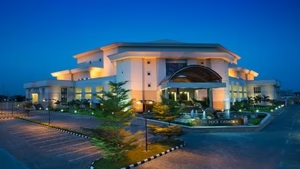
3D of Famfa Towers (Centre Point) Ikoyi, Lagos
Part Two
If the first part of our conversation traced Fred Coker’s journey into architecture and the experiences that shaped his career, the second looks beyond biography to philosophy. We discussed the projects closest to his heart, the changing nature of architectural practice, sustainability, the future of the profession and the qualities young architects will need to thrive in a rapidly changing world.
One thing became increasingly clear: for Fred Coker, good architecture is measured not by how dramatic it looks on the day it is completed, but by how well it performs decades later.

Choosing a Favourite
After so many years in practice, is there one project that stands out above the others?
That’s always a difficult question because every project brings its own challenges and rewards.
If I had to choose a residential project, I’d probably mention a house we completed on Ikoyi Crescent in 1993. I still think it worked beautifully, both inside and out. The site was long, so we positioned the house towards one end of the plot. That allowed the principal rooms to overlook a generous garden, with more than half the site dedicated to landscape and recreational space.
It was a simple planning decision, but one that made the house much more enjoyable to live in.
Winning the Big Commission
And what about your favourite commercial project?
I’d probably choose the Nigerian Intercontinental Merchant Bank Headquarters, later Access Bank Head Office, on Danmole Street. It was one of our earliest major commissions as a young practice, and looking back, I’m still proud of what we achieved. If I were designing it today, I’d probably do a few things differently. Architecture evolves, and so do architects. But at the time, it was an enormous opportunity.

We were competing against seven of the country’s biggest firms, yet we won. That project taught me something that architecture school never does—you have to learn how to win work. Being a good architect is only part of the job. Clients first must believe you’re the right person to trust with their investment.
Architecture Is Also About Relationships
You’ve often spoken about client engagement. Why is it so important?
Because architecture is ultimately a service profession. The more clients understand what architects actually do, the more they appreciate the value we bring. Many people think architecture is simply about producing drawings. In reality, that’s only a small part of the process.
You’re helping to manage decisions that determine how an entire project is delivered—its quality, cost, programme and long-term performance. Ironically, many clients readily pay investment managers to manage their money, yet hesitate when it comes to paying architects to manage projects worth many times more. That’s why communication is so important.
People value what they understand.
The Project That Raised the Bar
Which project has challenged you the most?
Probably the Famfa Towers (now Centre Point) on Kingsway Road. It’s challenging because we’re responsible not only for the architectural design but also for the engineering coordination. We’re working alongside Julius Berger, and anyone familiar with them knows they operate to exceptionally high standards.

Every drawing has to be precise. Every detail has to be properly coordinated. There’s very little room for error. It’s demanding, but that’s also what makes it exciting. Projects like that push you to become better.
Why ACCL Became Multidisciplinary
ACCL evolved from an architectural practice into a multidisciplinary consultancy. What prompted that change?
The industry itself changed. Years ago, clients were comfortable working separately with architects, engineers, quantity surveyors and other consultants. Today, many prefer a single point of responsibility. They want one team coordinating the entire process. That makes sense because managing the interface between different consultants can become a project in itself.
I’ve always compared it to football. If you’re expecting a coach to win the league, you also have to allow him to choose his team. When consultants work together from the beginning under one coordinated structure, there’s usually less conflict and far less finger-pointing. In my view, the advantages far outweigh the disadvantages.


Design That Lasts
What philosophy has guided your work over the years?
The first thing we think about is whether a building can be built properly and whether it will still perform well many years from now. That’s why we pay so much attention to detailing. Buildings should be durable. They should be practical. They should also be easy to maintain. I’ve never been interested in architecture that depends on gimmicks.
There’s an old saying that simplicity is the essence of good design, and I still believe there’s a lot of truth in it. Long after the excitement of a new building has faded, people are left with how well it actually works. That’s what really matters.

Sustainability Without Pretence
How do you see the role of architects in responding to climate change?
Sustainability is important, and architects have a responsibility to embrace it sensibly. At the building level, we should be thinking about better glazing, insulation, renewable energy and other measures that improve performance. Those changes are already becoming part of international building standards.
At the same time, we should also understand our local context. The solutions we adopt should make sense for our environment and our economy. Sustainability isn’t about following fashion. It’s about making better long-term decisions.
A Profession at a Crossroads
How do you assess the state of architecture in Nigeria today?
I think the profession is facing one of the most important periods in its history. AI and technology are changing how people work. Clients’ expectations are changing. Business models are changing. Every profession has had to adapt. Look at companies like Nokia or Blackberry. At one time, they dominated their industries, yet change eventually overtook them. Architecture isn’t immune. We need to take a hard look at where the profession is going and ask ourselves how we remain relevant in the decades ahead.
Ignoring change has never been a successful strategy.
Life Beyond the Drawing Board
Away from architecture, how do you unwind?
Golf. That’s really my main hobby. It takes quite a bit of time, so it doesn’t leave much room for anything else. But I enjoy it. Like architecture, it teaches patience. It reminds you that every shot—and every decision—matters.
Advice for the Next Generation
Finally, what would you say to young architects beginning their careers today?

I’d still encourage anyone with the passion to pursue architecture. It’s a rewarding profession, but it isn’t one for people looking for quick success. It demands patience. Commitment. Curiosity. Most importantly, we need to be willing to reinvent ourselves.
I’m not convinced the model we’ve followed for the last fifty years is necessarily the one we’ll need for the next fifty. The profession should be asking difficult questions about its future, and organisations like the Nigerian Institute of Architects have an important role to play in leading that conversation. If we remain open to change, I believe architecture will continue to make a valuable contribution to society.
Closing Reflections
Talking with Fred Coker, one quickly realises that his greatest contribution to architecture may not be a single building, but a way of thinking. Throughout our conversation, he returned repeatedly to the same values: patience, practicality, mentorship, durability and an unwavering commitment to professional excellence.
His perspective has been shaped by experience—watching buildings rise from sketches to completed projects, leading multidisciplinary teams, winning landmark commissions and navigating an industry that has changed dramatically over four decades. Yet there is no nostalgia for nostalgia’s sake. Instead, there is a clear-eyed recognition that architecture, like every profession, must evolve if it is to remain relevant.
Perhaps the most enduring lesson from Fred Coker is that good architecture is not about chasing the extraordinary. It is about consistently getting the fundamentals right—designing buildings that serve people well, stand the test of time and continue to justify the confidence placed in those who create them.
In an era captivated by spectacle, that may be the most enduring philosophy of all.

Fred Adeniyi Coker
Fred Adeniyi Coker is a prominent, award-winning Nigerian modernist architect and the Managing Director of Adeniyi Coker Consultants Limited (ACCL), one of Nigeria's most influential architectural practices. Known for reshaping Lagos city's skyline, his work merges cutting-edge contemporary technology, urban sustainability, and local cultural identity. Fred Coker is a Fellow of the Nigerian Institute of Architects (FNIA) and a member of the Royal Institute of British Architects (RIBA). He is also a past president of the Association of Consulting Architects of Nigeria (ACAN).

-
Teambooktu

-
Teambooktu
-
Teambooktu
-
Teambooktu
-
Teambooktu
-
Teambooktu
-
Teambooktu
-
Teambooktu
-
Teambooktu
-
Teambooktu
-
Teambooktu
-
Teambooktu
-
Teambooktu
-
Teambooktu
-
Teambooktu
-
Teambooktu
-
Teambooktu
-
Teambooktu
-
Teambooktu
-
Teambooktu
-
Teambooktu
-
Teambooktu


Discover more from Teambooktu
Subscribe to get the latest posts sent to your email.


Simply inspiring
This interview end-to- end is a tapestry of rich professional training, a can-do-spirit from early years, the power of interpersonal relationships in project execution, and a sublime architect’s mind at work, able to reimagine the future and prepare for it .
Makes me confident about the future of our unique profession in a fast-changing world.
I will recommend this to current students of architecture as well
William Uko III
Great work, Fred. The Famfa Towers is very impressive. I like that you highlighted simplicity, practicality and durability as key considerations in design. I enjoyed this read; its refreshing to get some insight into architecture.
Very enlightening. The architectural structures displayed are simply impressive works of art.