
KAP Film Village & Resort
Before ‘Afritecture’ became a thing, before the concept was coined by Leptik, it had strong proponents. We had advocates for culture, for sustainability. Adherents to the organic camp, to the hi-tech/recycling camp, the eclectic and community help camps. Some architects embodied them all. Theo Lawson was, and still is, one of such architects.
For architect, designer and creative director Theo Lawson, architecture has never been confined to buildings. His work has traversed architecture, art, stage design, cultural preservation, tourism and film, often bringing these disciplines together through storytelling. Last year, he was nominated at the AMVCA for Best Production Designer for The Man Died.
From his formative years at the Architectural Association (AA) in London to projects such as Freedom Park, Kalakuta Museum, the New Afrika Shrine and KAP Film Village, Lawson has consistently explored the relationship between architecture, culture, history and nature.
From Art to Architecture
You initially wanted to study art. How did architecture eventually become your path?

Yes. I actually intended to study art, but my folks wanted the sciences because Art was not a popular field in those days. But I didn’t have any combination of subjects that clearly led to a specific science-related course in university, so I went to England to do my A-level sciences. That didn’t really work out because I only had interest in Chemistry.
From school, I was one of the gifted artists, but art was never really a profession that anybody recognized at the time. So while I was in England, I told my brother that I was going to university to study art, but he wasn’t in support. Luckily, we had a mutual friend who was studying architecture at AA (The Architectural Association). He said, “You’ve got an arts background. Architecture here is more about the arts and stuff like that.” Now I always had a portfolio of my sketches and photography with me so I went for an interview at AA and, based on the portfolio, they accepted me on the condition that I would regularize my A-levels as we went along.
So I got into AA.
What was your experience at the Architectural Association?
I thought it was a very great school, but it was weird. Being a design-based school, there were a lot of people who I thought were mad (laughs). People were talking to themselves, talking about things I couldn’t understand. People brought fish or fish bones and other crazy things to school and talked about architecture abstractly.
But it was the starting point of my journey as an architect and a creative. I had so many projects that were purely conceptual in nature. Interestingly, Zaha Hadid was in her final year when I was admitted.
From Jos to Stage Design
After architecture school, you spent some time in Jos. What drew you there?
After I finished, I served in Jos. Prior to this, I had visited my brother in Jos during the holidays and fell in love with the place. I loved Jos — the serenity and nature. I planned to come back and settle there. After service, I stayed on for five years, but as most of my projects and clients were in Lagos, I eventually had to leave.
You worked on the Bauchi Museum while in Jos. Tell us about that project.

It was built with tubali – local earth construction. I visited MOTNA (Museum of Traditional Nigerian Architecture) in Jos and did a course with CRAterre (International Centre for Earth Construction) from France, who had come to give a lecture about stabilized earth construction. Then this opportunity came up. A friend of mine who was at MOTNA, and was also an architect, said Bauchi State was looking at rebuilding their museum and wanted to build it in earth. He recommended me to them.
It was an interesting project. I worked with skilled craftsmen and everything. The museum could have been bigger, but I was scared. I was using a material and technology I had never experimented with before. In hindsight, it could have been much grander.
What eventually brought you back to Lagos?
Economic conditions brought me back to Lagos, and I was also drawn back into stage sets because a friend of mine invited me. I formed Total Consult and was invited to design a stage set for a fashion show at Eko Hotel. It was massive and really, really interesting. I designed something architectural using fabric — fabric wrapped around wood, with internal lights behind the fabric. It was the first of its kind, so I was bringing something architectural to the table.

Fela, Music and Architecture
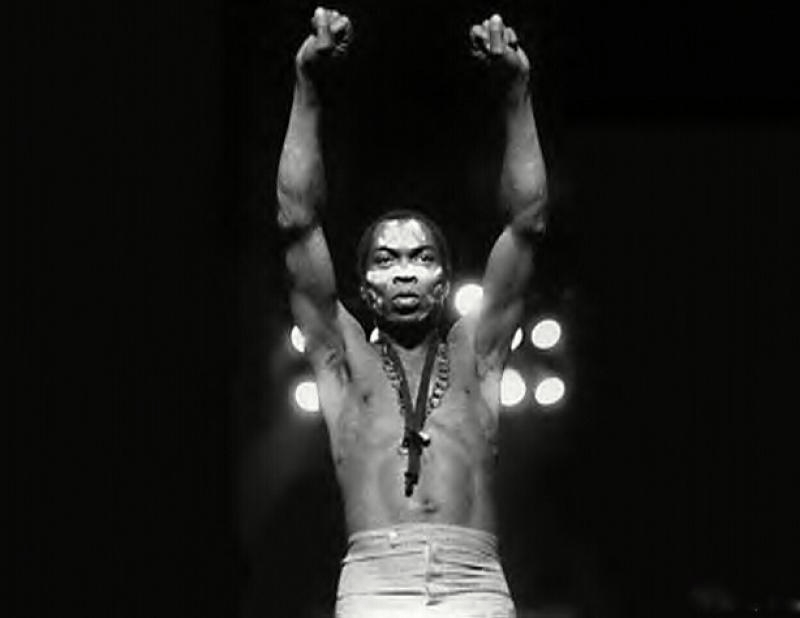

You later designed Lagbaja’s Motherlan’ and worked on Fela Kuti’s Kalakuta Museum. What was the connection with Fela for you?


Fela Anikulapo-Kuti had a major impact on my life when I was in school. I used Fela’s music as a reference point. If he could create this art and make it so popular, obviously, we have a voice. We have a right to claim the validity of our own art. Fela helped a lot of us African students get through school abroad. His songs also helped in the design studio. Music and architecture have a connection.
When Fela died, I met the family and volunteered to design and build his tomb. I was also commissioned to convert his third and final residence (Kalakuta Republic), which was run down at the time, to Kalakuta Museum. That’s also where his tomb is.
The tomb has a pyramid form, reflecting Fela’s Egypt 80 and African history. Any reason why you truncated the top? Any particular significance?

Well, not that symbolic. You know the top of a pyramid has a prism or capstone, the pyramidion. So I removed the pyramidion and was going to put a flame on top of it but it didn’t happen.
You’ll notice that there were four corners of a square at the base. These were meant to take four pillars. I was going to get four major artists to design the pillars. Bruce Onobrakpeya accepted to do one in fibreglass. Olu Amoda was supposed to do one in iron. Ndidi Dike was meant to do the third in wood, and the fourth was another famous artist for stone carving. Each material had a meaning: glass to reflect his transparency and easy way of life; iron, his strength; the stone pillar, his roots in Abeokuta; and the wood, his virility. Unfortunately, it never happened either, but the square holes are still there underneath the marble in case the pillars can be plugged in in the future.
What about the New Afrika Shrine?

That was a tribute to Fela built by his children. I did not design the building itself, but I did a lot of extensions within because essentially it was a shed. It had a lot of attic space. It was a steel structure, so there was an opportunity to utilise the space.
The first major intervention was to build a VIP gallery, which was on two floors. I built it into the small attic space. Later on, there was a side gallery and his shrine with a reflective pool. I had a mirror at the base of the pool to reflect his face in the water and give it an ethereal feel.
Architecture as Art, Storytelling and Experience
Your architecture is incredibly diverse. Why do you think architects do not venture more into other areas of the creative space?
A friend of mine once accused me of hiding architecture with art — that I used art to cover architecture and that it wasn’t real architecture. But the point is, architecture is life and life is art, and art is life. The artist, the architect, is a storyteller- like a griot. If we tell our stories and the story resonates with somebody — with your clients or with the end user — then you have made your point. As a concept developer, you need to understand the concept of why it is important to the client or to everyone who is an end user.
How do you handle the challenges that come with working with fellow creative minds as clients?
Well, a lot of my jobs are referrals so most of my clients know what to expect when they engage me. But I do sometimes have challenges with a few. For example, we enjoy the concept together and build up then we get to certain points where budget becomes an issue. They are now feeling like, “Okay, I can’t continue on this journey.” But it’s not about the money per se. I am a socialist in that sense. I do things, what’s the word… sometimes impulsively and creatively, based on what I think is best. Sometimes the client bounces back with, “Why didn’t you think of that before? Why is it just coming up? I paid for it. I paid for that in advance. So do it.”
So you just try to explain to the client that there is a process for delivering artwork. With science, you can say, put this in, that’s equal to B, or two plus two equals four. That’s distinct. That’s absolute. But when you’re dealing with art or abstracts, it’s not as easy as that.
Nature, History and the Making of Freedom Park
You have a keen interest in history and nature. How did that influence your work?
In my second year at AA, I joined the Tropical Design Unit, where I studied under Prof. Ron Lewcock, a professor of Tropical Architecture. This helped shape my interest in culture and nature designs. The projects were about designs made for here — made for Nigeria.

One of the projects I worked on in school was a market bridge designed to help preserve the old Carter Bridge before it was pulled down. It had a market on three floors, with the bottom being a fish market. That was partly why I fought so hard to get Freedom Park going. The old Carter Bridge was pulled down when I was a student. I didn’t have a voice and mine was just a school project. There was no way to push it.
Tell us about Freedom Park.
When I came back and this space was available, I pushed the Freedom Park concept before another big development could take it over.

In my third year at AA, I moved to Hi-Tech under Mike Davis, one of the principal architects who worked on the Millennium Dome with Richard Rogers. I learnt a bit of Hi-Tech and eventually fused both the Afrocentric and Hi-Tech approaches in coming up with Freedom Park. The skeletal cells replicating the old prison cell block were a tribute to Hi-Tech.

It was all about historical preservation. We preserved the colonial fence and restored or reconstructed sections of Broad St. prison.


You have also worked on other tourism and conservation projects.
Yes. The Lagos State Ministry of Tourism, Arts and Culture, under Mr. Oladisun Holloway, took me to the Conservation Centre where I designed the family park, the canopy walk (longest in Africa) and some other concepts. I also designed the proposed Tekunle Island Wildlife Park project in Epe, which never took off. It still hasn’t.
Then there’s the KAP Film Hub & Film Village. Both successful ventures into the Nollywood sector.

Thank you. I must say, however, at KAP Film Village, Igbojaiye, I was initially conflicted about the project because I love nature. Trees had to be felled to build it but I tried as much as I could to preserve as many as possible in my design.
Personally, I’m seeing African architecture going beyond materiality to symbolism, cultural beliefs, and background. So the concept of the hotel block in KAP Film Village is organic and trado-modern at the same time, bringing in the environment with natural stone, bamboo and wood finishes. All locally available. All its spaces are linked to one another internally from one end to the other. It’s like going for a walk through three blocks or a small hamlet. The oval spaces are symbolic of huts but in a modern abstract sense. The initial plan was to build them with stabilized earth bricks (SEB) but when this wasn’t approved, I finished the outer walls with tyrolean and mud-coloured paint to provide the appearance. Each unit had a day room and a night room like in our cultures.


I try to use local materials as part of the building’s character. Sometimes structurally, like with KAP Film Hub, where bamboo was used as part of the floor reinforcement for the raft foundation.


Difficult Projects, New Frontiers and the Future
Your motto is, “Impossible we do right away; a miracle will take a bit longer.” Many of your projects seem to reflect this.
Most of the projects we’ve done have been challenging in the sense that they’ve been very difficult to start off with. Fela’s house was a wreck and trying to bring that back was a big challenge. Freedom Park was an abandoned refuse dump. So was Funmilayo Ransome-Kuti’s house in Abeokuta, abandoned for many years.


We start with difficult challenges and have to work around them first for us to bring something out. That’s how most of our projects have been. Bericah Hills is another example. Not just the house itself but the topography. At first, these projects look daunting but the results make it all worthwhile for me in the end.


You have been involved in historical and ecotourism projects. What do you think Nigeria can do with its tourism potential?
Nigeria’s diversity has been so politicised that agreeing on one thing has always been an issue. Agreeing on things of mutual benefit has been very difficult, or made difficult by politicians. We are blessed with so much talent, human and natural resources, that we should be on top of the world. When we start thinking like that, and think of our importance to the world, building our confidence and understanding who we are, determines who and what we want to be.
Teaching ourselves that we are important in this whole thing will give us the confidence to stand and push. Our diversity is a strength. We should use it, build on that and say we are a land of colours — multiple colours, languages and so on. Using stories to try and fix things. That’s back to my point on storytelling.
You have also shown that architecture does not have to be restricted to buildings, particularly through stage design and film. How have you promulgated this view?
I can say many of the people who do stage sets successfully in Nigeria trained under me. Stage set was a quick fix — it seemed like easy money. But if you can visualise, do and deliver on time, and have the “liver,” because on the day everything must go right, you know. You have a one-time shot at this thing. You promise a client that it’s going to unveil like this. If it doesn’t, you are messed up. The entertainment and tourism industry has big market potential in Nigeria and there are opportunities. So a lot of the guys are training with us. A lot of architects too. I like to think that because we have a large number of interns, we are helping to develop people.
Finally, what would you advise young architects and those who want to try their hands at the profession?
The same thing I would advise anybody: know yourself. It’s about understanding and knowing yourself and asking: what is my message? What message do I want to bring forth? Because we all have contributions to make. Everybody has something that our Creator has put in them to come and deliver to mankind. Finding it is the most important thing.


Theo Lawson
Theo Lawson is an acclaimed visionary architect and creative designer known for his contributions to historical, cultural and ecological preservation as well as tourism. A fellow of the Nigerian Institute of Architects with a career spanning over three decades, his unique design approach seamlessly balances traditional African earth construction with High-tech design principles. Graduating from AA (The Architectural Association), London, he founded Total Consult who became well-known for stage set production and architectural projects like Freedom Park, Kalakuta Museum and KAP Film Village & Resort. He also co-founded the C.I.A., a collaborative group of local designers who spearheaded developmental and urban renewal ideas for the millennium evolution of Lagos. He was also nominated for Best Production Design in AMVCA 2025. He is a firm advocate for sustainability and trado-modernism in expression.
Discover more from Teambooktu
Subscribe to get the latest posts sent to your email.


