
Long before panels, speech balloons, or the imported gloss of Western superheroes, the peoples of the Niger area already lived inside a visual world where story and image moved in tandem. The Ninth Art did not arrive on an empty canvas. It stepped into a landscape rich with symbols, ritual marks, carved epics, and the spatial rhythm of oral narration. Nigeria’s comic history, often framed as beginning in the colonial print era, in truth stretches backwards into pre-colonial creative systems that functioned as early forms of sequential storytelling.
Pre-Colonial Roots: When Story Was Visual

Across the Niger area, story lived in form and pattern. The ideographic scripts of Nsibidi, the sweeping feminine geometry of Uli, the narrative bronze plaques of Benin, the carved panels of Yoruba courts, the masquerade ensembles that fused sculpture, cloth, and choreography, all carried meaning arranged in sequence. They were not static. They were read.

Each figure, motif, or mark held narrative weight. A single mask could represent an entire cosmology. A carved panel could compress history, myth, and memory. Griots and court historians animated these visuals with voice, gesture, and rhythm, the earliest fusion of image and narrative.
In essence, the Niger area already possessed the conceptual DNA of comics: sequential imagery, symbolic language, and storytelling across frames. The modern comic book would simply arrive centuries later in another form.
Colonial Influence: When Imported Panels Met Local Eyes

The arrival of missionary schools and colonial newspapers introduced a new relationship between text and image. Foreign comic strips; British humour series, adventure strips, and later American imports, began appearing in early twentieth-century print culture. Nigerian children and young adults encountered characters who looked nothing like them, yet the rhythm of panel-to-panel progression felt strangely familiar.

But it was in the pages of the nationalist press that the Ninth Art began to take on local purpose.
Akinola Lasekan, one of the key artists of the period, wielded the cartoon as political critique. Working with newspapers tied to the independence movement, his single-panel illustrations subverted colonial authority, echoed the anxieties of ordinary Nigerians, and established cartooning as a legitimate artistic and political tool. His work formed the earliest bridge between the imported comic strip and the indigenous visual voice.
BELOW- Powerman (1970s) British comic strip written by Don Avenall, Norman Worker & illustrated Dave Gibbons and Brian Bolland. It was created for the Nigerian market as its first black superhero. Created to encourage literacy and comics awareness.


By the 1970s and 1980s, Nigerian newspapers expanded into multi-panel comic strips. Andy Akman’s Kaptain Afrika and Kola Fayemi’s Terror Muda, among others, transformed the newspaper page into a stage for African heroes confronting recognisable social problems. At the same time, Wale Adenuga’s ribald and infectious Ikebe Super introduced a different kind of visual culture; irreverent, humorous, socially grounded, signalling that comics could speak in the language of everyday Nigerians.


Yet this was also an era shaped by import restrictions, political instability, and the complexities of the global cocaine trade. Ironically, the difficulty of obtaining foreign comics helped fuel local experimentation. For a brief moment, indigenous creativity flourished.
Post-Colonial Realities: Boom, Decline, and Rebirth

The late 1980s produced one of Nigeria’s most defining cultural interventions: Captain Africa. Akman’s black superhero stood as a pointed rebuttal to Tarzan and other colonial fantasies. He fought issues that Nigerians knew intimately; corruption, crime, and political turbulence, and gained international attention, including a feature in the New York Times.
But by the mid-1990s, the landscape shifted. Import restrictions loosened. Western comics returned en masse. Local production, once energised by scarcity, waned. Wale Adenuga moved his characters to television, political cartooning survived, but the home-grown comic ecosystem thinned.
Then, in the early 2000s, a football comic changed everything; the era of Supa Strikas.
First conceptualised in Nigeria before flourishing under South African stewardship, Supa Strikas became a pan-African sensation. Children collected issues through petrol stations, fast-food outlets, and banks. For many Nigerians, it was their first regular comic subscription. Its success proved that the continent could sustain local content at scale.

This momentum inspired other experiments, including corporate-driven superhero teams such as The Indomitables, blending marketing with narrative in a way that signalled a changing comic economy.

The Lagos New Wave: Rebuilding from the Ground Up
The true renaissance began in the 2010s. Studios like Comic Republic, Spoof, and Vortex introduced a new creative culture rooted in Afrocentric mythology, urban identity, and graphic sophistication. Lagos became the home of a movement. Comic Republic’s digital-first model made Nigerian superheroes accessible globally. Spoof Comics, now Spoof Animations, leveraged community and convention culture. Vortex merged tradition with contemporary fantasy, reminding readers that African cosmologies remain fertile ground for modern narratives.
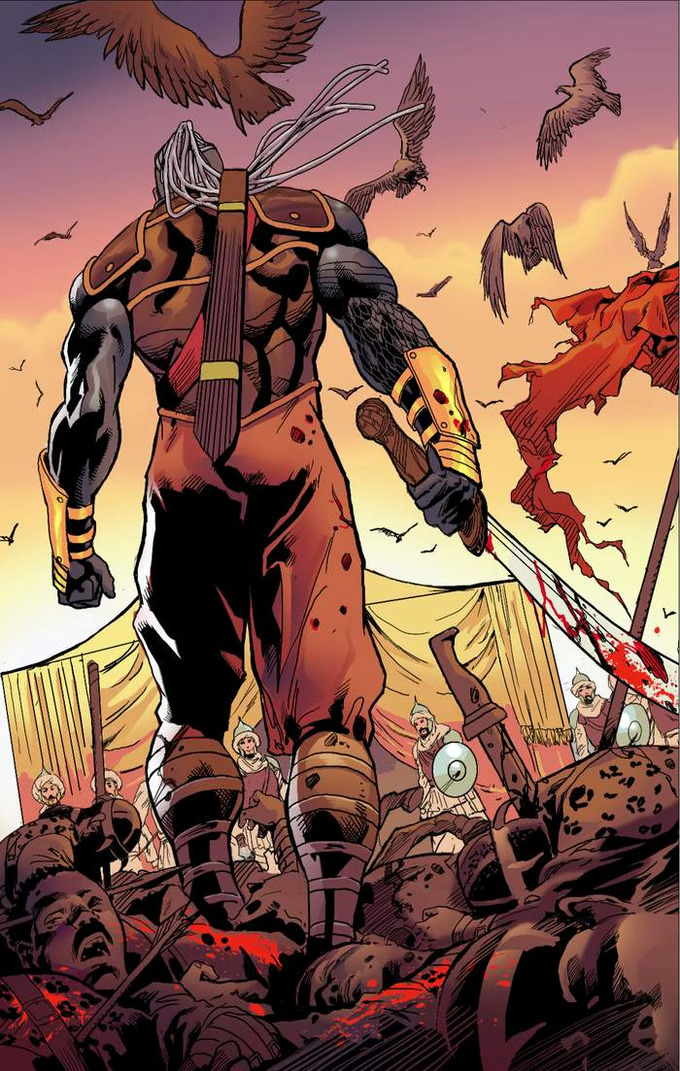
By the late 2010s and early 2020s, digital distributors like Webtoon, GlobalComix, social platforms lowered barriers for young artists who were simultaneously animators, designers, and developers. Studios no longer needed expensive presses or foreign distributors.


Figures like Erívic Adedayo embodied this shift: from Comic Republic intern to studio founder and cultural movement-builder. His contributions like MC Multiverse, Brown Roof Studios, Afroblot, and Comic Con Ibadan, became part of a decentralised, youth-driven ecosystem pushing Nigerian comics into new terrain.
The Comic Con culture wasn’t left out. Lagos Comic Convention, a gathering of geeks and comic book fans, gradually help build a comic community that will become recognised as one of Africa’s largest gatherings. For over a decade, it provided fertile ground for networking, comic book sales, and the promotion of an ecosystem. With time, Lagos Comic Con was no longer the sole arena, as new conventions inspired by its success emerged across Ibadan, Abuja, Benin, Port Harcourt, and beyond. Access to con culture became democratised. It built audience literacy. It connected creators to fans, investors, and opportunities.
The Ninth Art, once a colonial import, was now a Nigerian cultural economy.
Contemporary Griots of the Ninth Art

Into this unfolding history steps the likes of Teambooktu and TheACE, not as publishers or studios, but as the system-builder the industry never had. Where the early decades scattered creators across isolated efforts, they collect, document, and broadcast the narrative of Nigerian comics. Their work includes archiving, reporting, interviewing, covering conventions, building digital reach, fulfilling the role of the modern griot: preserving memory, shaping identity, and ensuring that future generations inherit not only the art but its lineage.
TheACE and Teambooktu emerged at a crucial moment: when the Nigerian Ninth Art is no longer emerging but crystallizing. They act as mirrors, witnesses, and accelerators, helping the soon-to-be industry recognise itself as an ecosystem, not a hobby. In doing so, they anchor Nigeria’s place, and Africa at large, in the global story of the Ninth Art.

Related commentary: https://teambooktu.com/ninth-art-3-manga-the-african-perspective

Mujeeb Jummah
Mujeeb Jummah is a Creative Designer and Visual Storyteller with over six years of experience building brand identities, multi-channel assets, and scalable design systems for companies including Co-creation HUB, VoltroxHQ, JAC Motors, and Zeta-Web. He is the founder and editor of The African Comics and Cinematic Empire (TheACE), a fast-growing digital media brand spotlighting the African comic and animation industry. With a background in Education and Economics from the University of Ibadan, and a passion for creative design, Mujeeb has led branding teams for events such as Comic Con Ibadan and TEDxUniversityofStirling. His work sits at the intersection of storytelling, culture, and creative innovation across Africa.
Discover more from Teambooktu
Subscribe to get the latest posts sent to your email.


Nigeria has come a long way. I like where we are currently, especially with Blood Wars, Metalla, etc. Can they be read online? A big thanks to Don Avenall and Norman Worker for creating our first superhero character.
Hello! You can get them Blood Wars via this link:
https://wiseacre.us/buy-comics/ols/products/blood-wars?fbclid=PAVERFWAOxUBdleHRuA2FlbQIxMABzcnRjBmFwcF9pZA8xMjQwMjQ1NzQyODc0MTQAAafCnT3EkDgSqhJfX33pK1YTagrMyhUjxcDDIjhcTRePZEDLnRmt_nmddL1-LA_aem_KzKvRUnDyA2hUjo8TAmvLQ